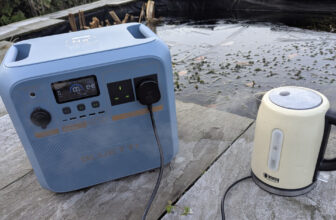
Anker Powerhouse 767 Review – a Lightning Fast Charging Power Pack

Anker PowerHouse 767 – What’s in the box?
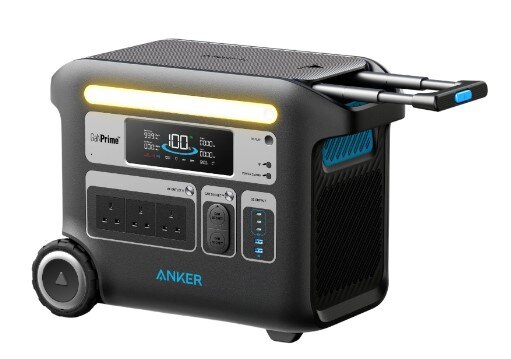 My expectations were raised when I saw the packaging the PowerHouse 767 came in. Anker had taken effort to include carry handles in the cardboard box so I could lift the box from the front door to my workshop – you’d be amazed at how many other manufacturers don’t do this, and you have no way of shifting the unit without removing it from the packaging!
So what do you get in the box? Well, Anker keep it fairly minimalist…
- Anker 767 – you’d certainly be a bit cheesed off if you didn’t get this!
- AC mains charging cable – aka as a ‘kettle lead’! Great that there is no external power brick required for mains charging.
- Cigarette lighter 10A car charging cable – for slow charging on the move
- 5:1 XT-60 solar multiplexer – allows up to 5 solar panels to be connected to the PowerHouse 767 for a maximum solar input power of 1000W. Nice!
- User manual and warranty certification
Size and Dimensions
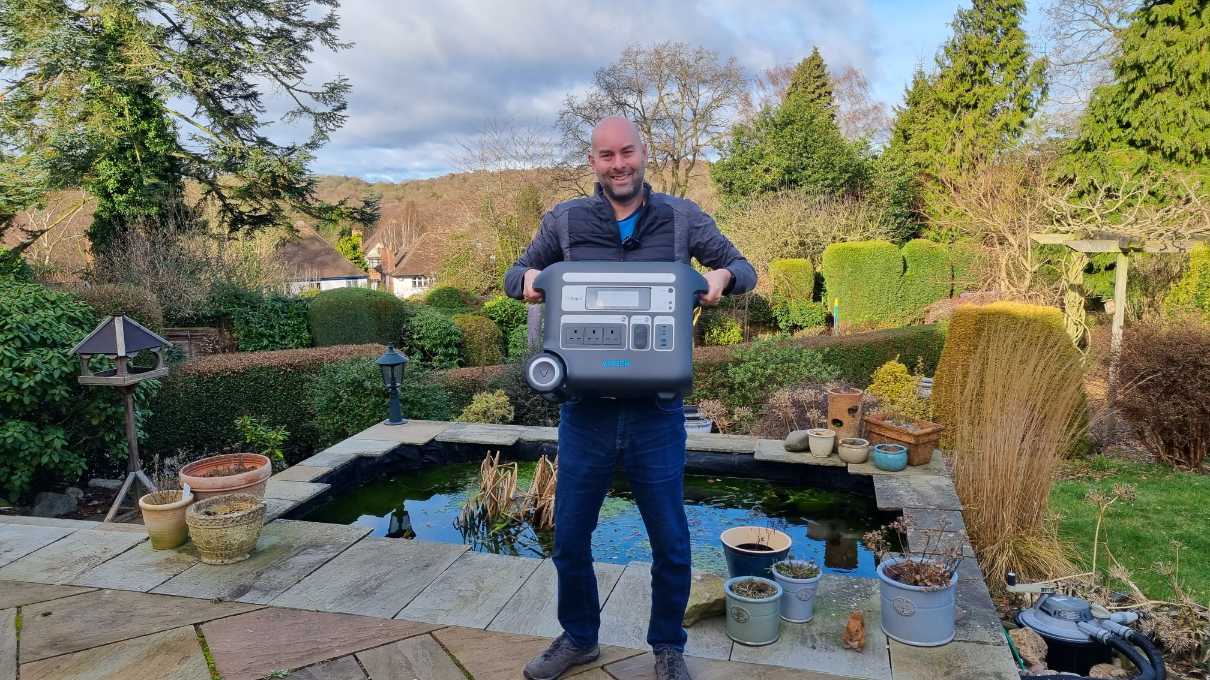
The Anker 767 is a large power station – of that there is no doubt. It contains a very decent storage capacity of 2048 Wh, but to hold that amount of battery cells takes up some room in the casing. As a result, this is one of the largest power stations we’ve tested, and is right on the limit of what you might consider taking camping.
The 767 measures 52.5 x 39.5 x 25 cm for an overall casing volume of 51843cm3. It will take up substantial room in your car boot or campervan if you’re planning on taking it away for a camping trip. That being said, with the functionality it provides this could well be a sacrifice worth making.
It’s also heavy at 30.5kg. In part this is due to the use of lithium iron phosphate battery technology (LiFePO4 or more simply “LFP”) which is less energy dense than standard Lithium-NMC. You need more battery cells in an LFP-based power pack to get the same capacity as an NMC-based one.
That being said, LFP-based power stations are now becoming the norm because they are safer than NMC and also allow many more charge/discharge cycles before degrading. Anker say that the 767 will lose a fifth of its capacity over 3000 cycles. That would be a full charge/discharge every day for 8 years, and you’d still have 1640Wh of nameplate capacity left after those 8 years!
When you’re choosing a battery technology for your power station you should really decide how often you will be using the power pack. If it’s occasional camping use then I would ignore the battery tech and get the power station which has the size, weight and features that satisfy your needs. If you’re planning on continuous charging/discharging at home or on the road by mains, 12V or solar then I would go for LFP because of the enhanced lifetime performance.
Handle and wheels

One of our favourite parts of the 767 is the fact that it has two large wheels (4.72 inches) and a hidden telescopic handle which extends from the top surface of the power station and enables you to wheel it around like a piece of luggage.
The telescopic handle is excellent, and you would not know it’s there because it is so well hidden away when not in use. You simply press a release button and it can be extended out and the 767 wheeled away.
Anker describe how they’ve taken extreme care in the internal design and unibody construction of the 767. They say that it can be wheeled over all sorts of ground conditions and that the bouncing and rolling from cobblestones for example will not cause any internal degradation or connections working loose. Anker estimate that you can drag the 767 for 125 miles via the handle and wheels with no issues!
There are also two carry handles moulded into the body of the 767 which means you can lift it up fairly easily. However, you need to bear in mind that 30.5kg is pretty heavy and you’re not going to be carrying this long distances.
Key Features
Storage Capacity
As mentioned above, the Ank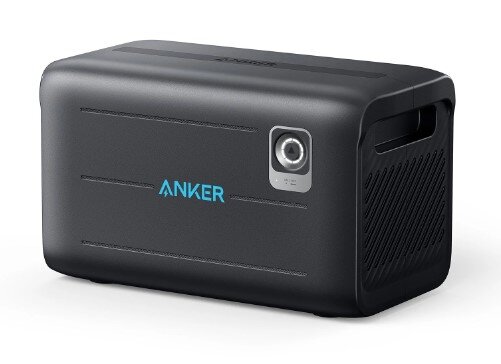 er 767 offers 2048Wh of expandable capacity. This is a very decent amount, and means that it will run a 50W camping cool box for around 36 hours – just enough for a weekends camping without any form of additional available power (solar, 12V or mains).
The battery capacity can easily be doubled by buying a separate expansion battery of another 2048Wh. The advantage of doing this is that it is much cheaper than buying two separate 767 stations for the same 4096Wh total capacity. The total cost is around 40% cheaper doing it this way.
Inverter Power
The PowerHouse 767 offers an onboard inverter of 2300W power. This represents the total steady state power which can be sent out of the powerpack from all of the outputs (AC, DC, USB) combined. See below for a full list of the output ports.
This is a really decent amount of power for camping and means you can power all sorts of appliances and charge up your phones and laptops etc.
 We’ve had success powering the following items with the Anker 767 PowerHouse
- 2kW kettle
- 4 slot toaster
- hairdryer
- camping heater
- camping cool box
- electric camping stove
In addition to the above steady state power limit, the 767 can also surge in power for short periods of time up to a maximum of 3200W. This was enough to boil a 3kW kettle of warm water in about 1 minute. Impressive.
We did find that when you’re running the 767 close to its maximum power draw that the fans kick in at full speed. This can be quite noisy, and also reduces the total amount of power available to use (because the fans are using up some of the power themselves). See below for our efficiency tests on the 767.
Gallium Nitride Prime
Without getting too technical, the 767 uses Gallium Nitride for its internal electronics instead of the more traditional silicon-based electronics used by otther manufacturers. Gallium nitride helps keep the temperature of the 767 down under heavy charging, and also saves energy for the charging process – this improves efficiency.
Anker also use industrial-grade electronics components in the 767 which are expected to last up to 6x longer than standard components.
Anker 767 – the Front Panel
So let’s take a look at the display and outputs of the 767, which are all located on the front panel.
Lantern
At the top of the front panel is an LED strip with a button to the right of it. Pressing this lights up the lantern functionality, producing a decent amount of light with three different levels of brightness. Just keep pressing the button to access them. Pressing again creates an SOS emergency signal, and then again turns the lantern off. The lantern is great for camping.
Display
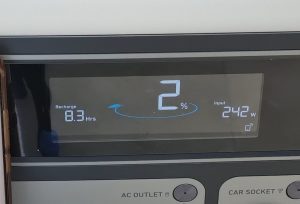 Below the LED strip is the main display of the 767. It’s a very clear display which shows all the essential information that you would hope to see for a modern power station. In bright sunlight it can be difficult to see, but you always have the smartphone app to access the same information if that’s the case.
The display shows:
- Input power
- Output power
- Percentage capacity left
- Time left to fully recharge (if charging)
- Time left to fully discharge (if not charging)
The last two time estimations are especially useful to see on a power station, and proved to be pretty accurate in predicting the remaining time left at the current rate of charging or discharging.
The display also shows up alarms (if necessary) and also whether the low-power ‘ECO’ mode is active which turns off all sockets after 15 minutes if no power is drawn.
To the right of the display is the main power on-off switch for the 767. Below that is the button to turn on/off Bluetooth connectivity for the smartphone app. Below that is the button to activate ‘ECO’ mode.
Output Power Sockets
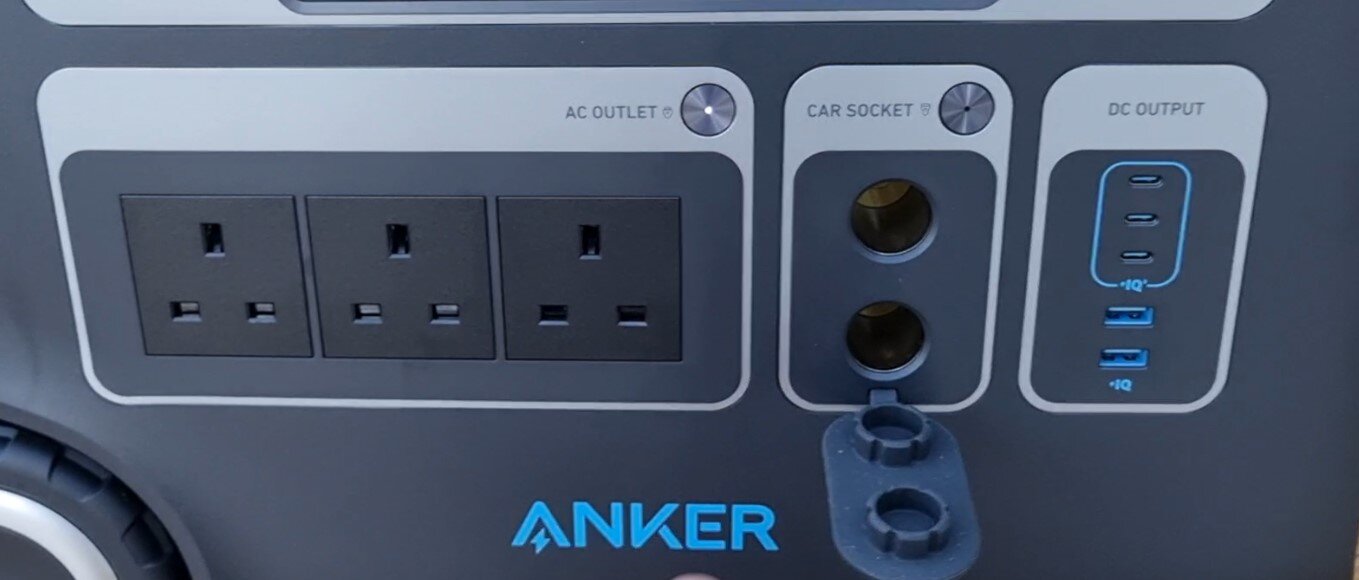
The 767 has an excellent array of AC, DC and USB sockets for powering your devices. The AC sockets and the DC/USB sockets have their own on-off activation buttons which must be pressed to enable power delivery. You can also activate these from the smartphone app.
AC Power
On the UK version of the 767, there are 3 x AC sockets of the 3-pin 220-240V variety. In the USA, you get 4 x AC sockets, but this is due to USA plugs being smaller than the UK plugs.
I feel that three sockets is definitely a good amount, and while it may not be class leading (the Bluetti AC200Max has four), it is enough to comfortably power a typical number of home or camping appliances. If you need more sockets then you can also plug in an expansion socket of course.
DC 12V Power
Next to the AC sockets are two 12V 10A DC sockets which allow you to plug in two cigarette lighter style plugs. These could be from a cool box or other fairly low power devices. It’s unusual to see two of these sockets on a power station, and this is a good addition I think.
The two sockets are covered by a rubber shield when not in use to keep an elegant look to the front panel.
USB Sockets
The Anker 767 really shines with USB power. It has a whopping three of the 100W high power USB-C sockets which can be used to directly charge and run the latest laptops without requiring a separate AC mains power brick. Much easier and more convenient to use USB-C.
Having 3 x 100W USB-C sockets is class leading, and a real plus point of the 767 PowerHouse. Most of the competition only have one or two at the most – great work Anker!
In addition to the USB-C sockets you also have two standard 12W USB-A sockets if you need to use those for your devices.

The Anker 767 PowerHouse In Use
Charging
Charging via Mains
I was absolutely blown away by the speed of the charging on the 767. It is insanely fast and easily the quickest of the current crop of powerstations from any manufacturer.
I had completely emptied the power station (0% capacity) and plugged the kettle lead into th back of the 767 to charge. Input power starts at around 240W until the capacity gets to 2%, and then the input power rockets up to just over 2kW!
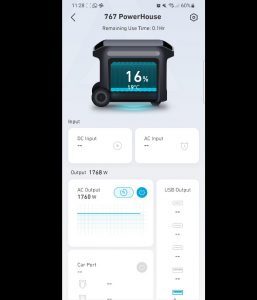 This can all be monitored from the smartphone app which is very simple to connect to the 767 using Bluetooth.
In total, I was able to charge the 767 from 0 to 80% capacity in only 56 minutes – incredible!
Charging all the way from 0 to 100% took 1hr 10 minutes – again incredible and the fastest we have tested for 2048Wh capacity.
Charging via Solar
The 767 can charge with solar at up to 1000W in total. It incorporates a full MPPT controller which can take 11-32V at 10A from your panels or 32-60V at 20A.
With 5 x 200W panels connected through the XT-60 multiplexer supplied, you can charge the 767 from 0-100% in about 2.5 hours. However, of course this depends on how strong the sunlight is and that the panels are optimally angled towards the sun. In the UK, this is often not possible and it can be very difficult to get enough sunlight from small, folding panels to fully charge up a big power station like the 767.
We plan on testing the solar performance when we get a bit more sunshine in Birmingham. However, we have no reason to doubt the Anker specifications and capability.
Mixed Solar and Mains Charging
One thing to also note is that if you’re planning on hooking up solar panels and mains input power to the 767, the station will only charge from the mains. This is a bit of a downside in my view because I would always prefer that the maximum power comes from the free solar energy rather than the mains power you might be paying for. It’s a strange decision by Anker on this and certainly worth bearing in mind if that’s an arrangement you were thinking of running.
Discharging and Efficiency
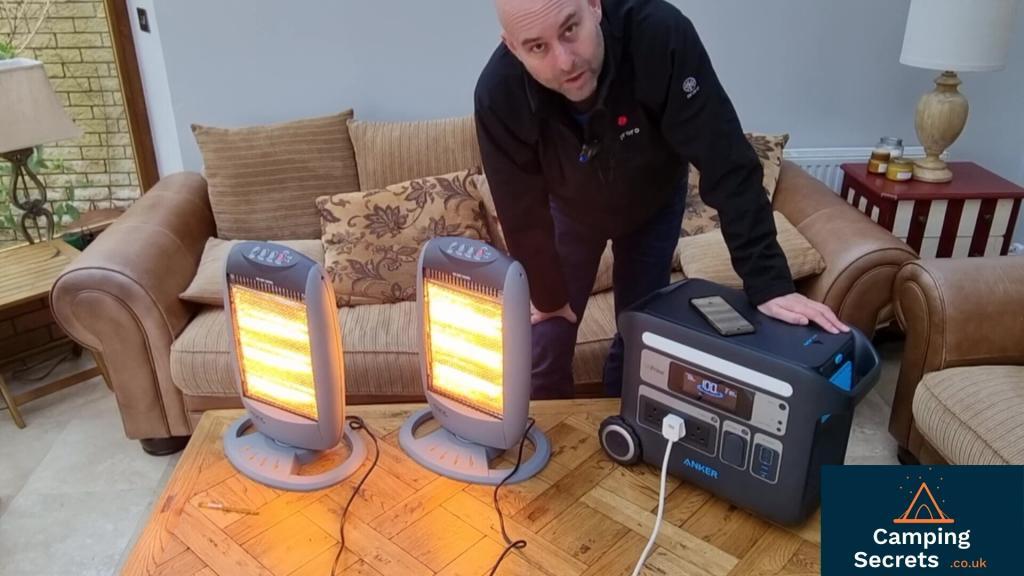
I ran some discharge tests with the Anker 767 to measure how much actual storage capacity is included in the battery cells. Remember that the power station uses up energy running its fans, inverter and electronics, and this can be a sizeable percentage of the total. The best power stations are around 90% efficient, but we have seen some as low as 73%.
Rapid discharging efficiency
Slow discharging efficiency
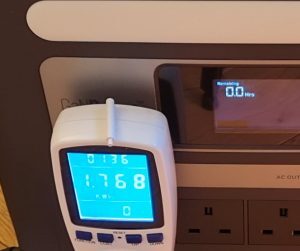
For a more realistic discharge, I ran the test again with just a single heater in operation. In this case, the useable power was a much healthier 1768Wh which is an efficiency of 86% – pretty good!
The efficiency of any power station is a very important parameter. If you’re paying £1 to charge up the unit but then only getting 70p of power out, you’re paying 30p for the privilege of using it as well as the cost of the power station in the first place.
86% efficiency is very good and one of the highest we’ve seen for an LFP battery pack.