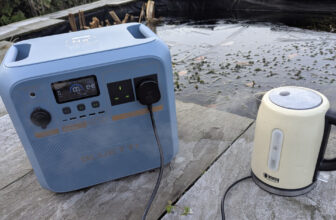
Jackery Explorer 500 Review – A Portable Power Station

Jackery are an American company who recently celebrated their ten year anniversary. They specialize in clean electricity generation and associated power storage in rugged battery packs for camping and off-grid living. We like the cut of their jib in a world of rapidly rising gas and electricity prices, and have been itching to properly test some of their gear to see how it could help our lifestyle – both at home and when camping.
We were lucky enough to recently get hold of their mid-range Jackery Explorer 500 battery power station and the SolarSaga 100 solar panel for some in-depth testing. The two products can be bought and operated separately (this is worth thinking about because surprisingly even the solar panel can charge small electrical gadgets on its own), or alternatively bought together as the Jackery Solar Generator 500. If you choose the latter then you can save some money as the combined bundle works out slightly cheaper than the separates.
What is the Explorer 500?
 So what are these products, and who are the target market? Well it’s actually a fairly simple proposition, but executed extremely well. The Jackery 500 is a lithium power pack, similar to the small power packs which you can use to charge up your phone when you’re out and about and nowhere near a mains plug. The difference is in the size and range of outputs on offer with the Jackery offerings.
The ‘500’ in the Explorer range firstly signifies 500W of power output (i.e. how much ‘oomph’ it has) and secondly, it refers to the onboard power storage of 518Wh – this is the amount of power in the tank. 518Wh means that this version of the Explorer would power a 518W hairdryer continuously for one hour, or a 25W camping lantern for 20 hours – the choice is yours how you consumer the power once it’s in the reservoir. It can power AC or DC sources as well as provide USB power for all manner of gadgets – we’ll get into the detailed specs later in the review.
Battery Pack Applications
So who are they for? Well, we can see a use for these types of gadgets in a range of scenarios. For example, you may wish to have an alternative source of power on tap at home in case of power cuts, or simply if you wish to take advantage of lower electricity costs at night – charge up the Explorer when the ‘leccy’ is cheap and then use the power at peak times when the costs have risen. Alternatively these power packs are great for outdoor hobbies like drone flying, whereby you can charge gadgets on the fly, literally! Finally, there is the camping, boating and general off-grid outdoor life uses. Having a power source on tap could be invaluable to making your time away more enjoyable and even potentially safer.
Other Versions in the Explorer Range
If you need more power than 500W then Jackery do sell more expensive 1000W and 1500W power stations in the Explorer range, and this can massively extend the range of items that you can power. This is certainly worth investigating if you are likely to need to power a kettle or mini-oven for example. They also sell smaller capacity options if budget or packing space is limited, but I can see more limited use cases for these – certainly for our family camping life.


Charging the Jackery 500
The Explorer 500 comes complete with an AC power adapter for mains charging and a 12V car cigarette lighter adaptor for charging in a vehicle. Make sure the engine is going though or it will drain your battery. Both chargers have a decent length of cable and end in an 8mm adapter which fits snugly into the Input Socket of the power station. Check out our labelled diagram opposite. This is also the socket into which you can plug the output from the SolarSaga 100 solar panel. When power is turrned on, or the sun is shining then a blue LED next to the input socket lights up and the display will show the amount of power entering the Explorer. Be aware that the max input power of the Explorer 500 is only 100W and so you cannot combine two solar panels for faster charging (which you can on the Explorer 1000).
Explorer 500 Output Ports – Harnessing The Power
As mentioned, the Jackery Explorer 500 is a mid-ranged and mid-priced power station. As such, you don’t get the full panoply of outputs that you might see on alternatives like the EcoFlow Delta 1300 or even the Explorer 1000. In part this is due to the size of the device, and needs to be part of your decision making process when buying. Can you live with only one AC outlet for instance? You can always pack a 3-way extension cable to split the AC power.
There are three USB-A outputs on the Explorer 500, all using the standard 2.4amp output which is perfectly fine for phone charging. I was slightly surprised not to see at least one higher power USB-PD socket on board with 5 amps of output. Once you’ve experienced high power fast phone charging, you don’t want to go back. There is also no wireless phone charging offered, unlike the lower-powered 300W Bluetti/Poweroak AC-50S.
Finally, there are three 12V output ports. One is the standard 10 amp car cigarette lighter socket which can drive a range of camping gadgets including lights, cool boxes, 12V TVs and kettles etc. There are also two 6.5mm 7 amp 12V sockets included which may be a US standard – I’ve never seen any product which uses them!
 After unboxing the Explorer 500, the charge level was at 44%, and so I tried the AC charger as a first attempt. It takes around 7.5 hours in total from 0-100% and that ties up with the 3.5 hours it took to reach 100% for me.
I ran straight up to my music room and plugged my Boss Katana guitar amplifier into the Jackery and pressed the AC-power button. I then switched on the amp and was able to play with absolutely no problems.
I then jumped into our Marco Polo campervan and drove to the nearest park for some outdoors experiments. I was able to easily work on my laptop with the Explorer 500 providing charge while I worked on the Camping Secrets website – I can see that this device would be excellent for working in the van away from home if I fancy a change in surroundings from the house – a mobile office!
Coolbox Operation
 I then plugged in our electric coolbox. This draws around 50W and so would flatten the Explorer 500 in around ten hours of continuous use without the solar panel attached. It worked extremely well and was soon cold enough to chill some cans of coke I had brought along for the morning.
Finally I had a go at powering something a little more potent. We keep a Kenwood whisk on board the campervan which is rated at 450W – just less than the maximum 500W level of the Jackery. I was able to operate this on all five power levels successfully which was really satisfying and impressive.

Jackery SolarSaga 100 – Charging the Explorer via Solar Power
 The Jackery SolarSaga 100 is a foldable solar panel which can be used on its own or in conjunction with any of the Explorer range from the 300 and above. On the larger Explorer 1000 and 1500 you can double up the panels for faster charging, but this is not possible on the 300 or 500.
The panel folds in half when not in use and measures 61 x 53.5 x 35 cm. The two halves of the panel are joined together with magnets which work surprisingly well and can hold it firmly shut. The weight of the panel is light at about 4kg (Jackery say 4.69kg but we measured lighter).
The SolarSaga 100 has a nice orange ruggedized handle which makes it easy to carry around. On the back of each half of the panel there is a leg which can be pulled away from the main surface (it is attached using Velcro) and then used to prop up the panel to face the sun at an angle. The angle can be adjusted although it is not as flexible as an adjustable stand or even plastic or metal legs would be.
 The back of the panel also features the output port of the onboard MPPT controller (the electronics which regulate the power delivery). There is a long cable which plugs into the Jackery Explorer power station, but the panel can also be used with other brands of power station. However,you may need an adapter to convert the 8mm Jackery plug to the one used by the other brand.
There are two additional outputs on board, both USB. There is a standard USB-A socket and also a USB-C. This is surprising to see as there isn’t one on the Explorer 500 and is actually quite welcome for directly charging modern phones and laptops.
One consequence of having these onboard outputs is that you can actually charge your gadgets directly from the solar panel and not bother with the Explorer 500. Of course, you are then reliant on there being sufficient sunshine, but it’s certainly welcome functionality to have.
Simultaneously Charge and Use Power
On a windy day of testing I was lucky enough to get some winter sun in the UK to try charging the Explorer 500 using the SolarSaga 100. One great feature of the combination is that you can charge the Explorer at the same time as you are powering your gadgets with it. Very nice and helps illustrate how you might achieve continuous off-grid living.