Jackery Explorer 1000 Review – A Solar Powered Reservoir

As a campervan-owning family, we often want to park up in isolated spots and enjoy what nature has to offer us. This might be at a campsite, on moorland, or simply at the side of the road. If we take the campsite option then we typically pay for a mains hookup to give us 240V of lovely AC power – this means we can run hair dryers (not much use in my case), charge all our gadgets and generally live life as we do at home.
The problems come when we are in the middle of nowhere, at a campsite or parking spot which does not have the mains hookup option. Some would call this ‘real camping’, but we tend to call it ‘wild camping’. In these cases, there are a few options to survive:
- Ignore all gadgets and just relax – cooking with gas!
- Use the in-built 12V leisure battery – this can run the fridge or coolbox for a couple of days but is not much good for longer holidays.
- Bring along a solar-powered battery power station which is capable of powering most of your camping gear.
The latter option only really became viable in recent years with the advent of Lithium Ion, and now Lithium Iron Phosphate batteries. These cells allow multiple charge/decharge cycles in a small package with high output power delivery. When incorporated into a product with an onboard inverter, it’s possible to get AC and DC power from a small pack which can be charged by a solar panel – effectively, the power pack becomes a perpetual energy source using 100% green energy (ignoring the mining and ultimate disposal of the elements used in the batteries and electronics).
Jackery Explorer 1000 – Product Description
 Jackery are pioneers in green energy storage and we always look forward to testing their products as they regularly impress with their design and build quality. They are regulars on our list of best camping power packs.
Unboxing the Explorer 1000 gave me that familiar feeling of quality. A standard cardboard box contained a branded cardboard box containing the power pack and leads, with the whole ensemble encased in polystyrene protection. No chance of delivery damage here.
The Explorer 1000 is an upgraded version of the Explorer 500 we recently reviewed and is superior in terms of specifications in nearly every way, albeit at a higher price point. The product look and feel is almost identical however, and we like this ‘family feel’ which Jackery imbue in their products.
A large overhead handle enables easy lifting of the Explorer 1000. The power pack weighs a fairly meaty 10kg, but it’s easy to move around, and certainly practical.
The 1000 measures 33.3 x 23.3 x 28.3cm and is roughly cuboid in shape, with a rather fetching dark grey and orange casing design. The four padded feet under the Explorer 1000 are also orange, and overall it looks very natty.
The key features for use are located on a single front face of the Explorer. Here are multiple input and output options for charging and discharging both the Jackery and your gear. There is a useful multi-function LCD display which can be easily read in bright sunlight (unlike some of the competition).
Storage Capacity and Power
The Explorer 1000 contains a full battery management system and 1002 Watt hours of lithium-ion battery cells. This means that it could power a 1000W item like a travel kettle (see our video below) for one hour, or alternatively a 50W laptop for 20 hours continuously – pretty neat.
In terms of power delivery, the Explorer 1000 can power up to 1000W appliances continuously, and can cope with a momentary surge of power at start-up of 2000W. This surge power limit is useful because many gadgets use more juice immediately at start-up before dropping back under continuous operation.
What can it power?
Check out our Camping Secrets video below showing what typical household items can and can’t be operated via the Jackery Explorer 1000. You may be surprised at how much juice it can chuck out.
Jackery Explorer 1000 – Inputs
There are two input ports on the Explorer 1000 – a standard 8mm female connector input and a pair of Anderson Power pole connectors.
The 8mm input is can be used with the 240 V AC power supply and 12V DC cigarette lighter power cables which are included in the box. Charge time from 0-100% is around 6hrs 45 minutes using AC power, and slightly longer at around 7 hours using the car charger. You can also plug in a single Jackery SolarSaga panel into this connector which can supply around 65W under full sunlight. Charge time then is around 16-17 hours, and could be even longer under cloudy conditions.
We review the SolarSaga 100 panels separately in our best solar panels article.
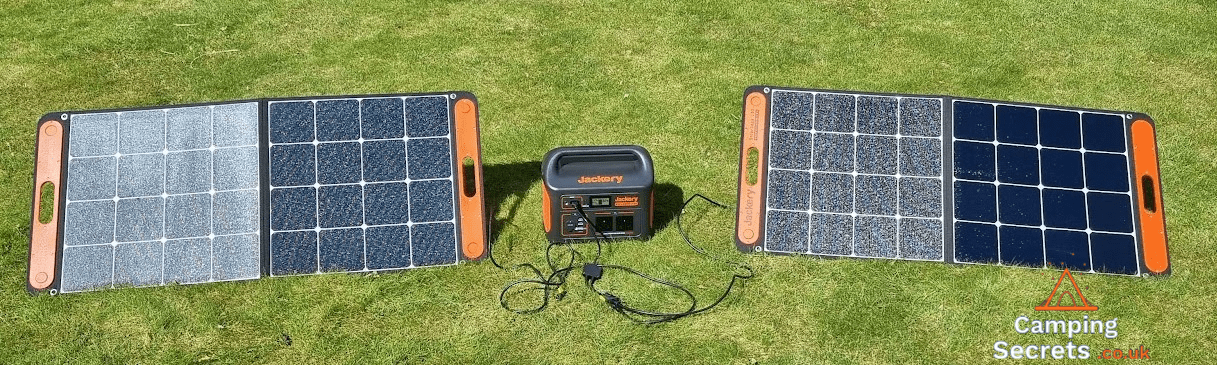
Luckily, two SolarSaga panels can also be connected together in parallel and connected up to the alternative Anderson powerpole input on the Explorer 1000. This requires the use of a dual Y-cable which came in the box and turns the Jackery into a fully green solar machine. Charge time with two panels reduces to around 8 hours in full sunlight, which can be managed in a day if you’re in the UK during summer and are a lucky individual…. Note that you need to adjust the panels to face the sun every so often in order to maximize generated power from the panels.
It’s worth mentioning that you cannot use both the 8mm input and the Anderson input at the same time for charging – it’s one or the other.
Output Connectors – Powering Your Gadgets
The Explorer 1000 has a range of outputs for both AC and DC appliances, and we found that it catered pretty well with most camping requirements. Output sockets include:
- 2 x 230V AC three-pin sockets which enable you to power AC devices as long as the combined power drawn from both sockets is <1000W. The AC power must be activated with a small button above the sockets which causes a standby power draw of a few Watts, even with nothing attached.
- A single 12V ‘cigarette lighter’ style socket with a maximum current draw of 10 amps. Useful for electric cooler boxes when camping.
- 2 x USB-C ports for directly charging phones or modern laptops
- 1 x USB-A standard port with 2.4A current at 5V (12 watts)
- 1 x USB-A with quick charge 3.0 for fast charging of gadgets (36 watts)
There is no wireless phone charging capability with the Jackery which I was a little disappointed to see. However, having the rugged carry handle on top of the power pack is more important than having a wireless charge pad there in my opinion.
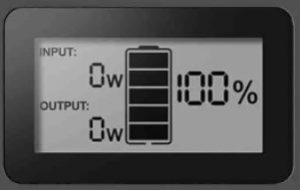 The monochrome LCD display of the Explorer 1000 is exactly the same as that on the smaller Explorer 500. It is not flashy, but shows the input power and output power clearly, as well as the % capacity remaining. I found that the display worked well in bright sunlight, which is not always the case with more fancy colour screens. To view the display in the dark, there is a button to activate a backlight – however, I found that it did not stay lit for very long (about 10 seconds) which was a bit surprising when there is so much power available. I also think the backlight should be on permanently when the Jackery is being charged.
Jackery Explorer 1000 in use
 I found the Explorer 1000 a much more compelling power pack for camping then the lower-powered 500. The extra 500W of power makes all the difference in terms of what can and cannot be driven by the Explorer 1000. Check out our videos above and below for a full list, but I got the following to work extremely well:
- Two slot toaster
- Henry vacuum cleaner
- Leaf blower
- Ebike battery charger
- Blender
- Fan
- 2kw Fan heater at 50% power
One thing I did notice was that under heavy loading the Jackery does fire up its own internal fans which can make a bit of noise. In a quiet house this is noticeable, but when camping you cannot really hear them. They are nowhere near as loud as the EcoFlow Delta 1300 we recently reviewed.
Low Power Kettle
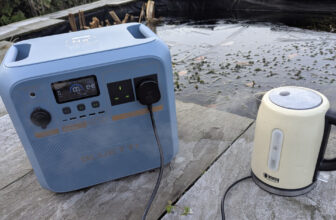
 One item I was very keen to get working with the Jackery was some form of camping kettle. The Explorer 1000 can’t drive normal kettles as they are typically in the 3kW range. However I found a low power Quest Kettle on Amazon which miraculously worked with the Explorer 1000, and boiled over a litre of water in around 7 minutes – not too shabby at all! The power draw of the kettle was slightly over 1000W at around 1050W but the Jackery was able to supply that, even though the steady state max is quoted as 1000W. Impressive!
Check out our video below of the kettle boiling experiment!
One area in which the Explorer 1000 is not very competitive for UK conditions is the charge time. Under AC power, the Jackery can be fully charged in around 6.5-7 hours, which is a considerable portion of the day, and is much slower than equivalent products from their big competitors Bluetti, EcoFlow and Anker. Jackery themselves have come up with a new ‘Pro range’ which has much faster charge times.
Does charge time really matter? Well in a sense, no it doesn’t – you can still use the Jackery products as they are being charged, and as long as you are drawing out less power than you are adding in via charging then your overall battery level will go up. However, max power input is only around 130W, and so in that scenario you are limited to quite small appliances if you want to both increase the stored charge and use appliances at the same time.
The situation gets even worse with solar power, especially in the UK. The SolarSaga 100 panels give around 65W of input power to the Jackery each, so two in parallel are also around 130W – however, this is only the case under direct, bright sunlight conditions. Unfortunately, in the UK this rarely occurs, and even if it’s a sunny day, the angle of the sun changes as the earth revolves. This means you need to be regularly re-angling the panels.
 On a sunny UK day, I set up the Jackery Explorer 1000 in bright sunlight with two Solar Saga panels and attempted to charge from a 25% initial level. I did not re-angle the panels and just left the system for 5 hours. At the end, the Jackery was up to ~50% which equates to around 250Wh of capacity being added – i.e. I had added about 50Wh for every hour I had been charging. This wasn’t a bad result, but under cloudy conditions I feel that you would not be able to rely on the sun to get from 0% to 100% in a full day, even without drawing any power whatsoever. Add in some power draw for a cool box say, and the situation would be even more extreme.
Overall, I feel there is a balance point which can be reached, whereby you could balance a small amount of power draw (e.g. laptop and coolbox) against the input power which can be generated from two solar panels and a cloudy UK day. Is it too much stress to try and do this? Perhaps, but simply having access to free power in this way is so liberating that you cannot really complain about not getting enough power due to an overcast sky – it’s just a result of living in a country like the UK rather than Arizona!
I definitely think that having solar panels on the roof of your campervan or caravan is the way forward, so that the Jackery can be charged whilst you are driving around and not using much power. Then when you get to your destination, set-up the Solar Saga panels and start charging with them. Yes it’s an expensive solution, but is probably the best combination to reliably keep the Explorer 1000 fully topped up as much as possible.