Aferiy P310 Review – the Ultimate Budget All Rounder?
AFERIY P310 Review: The Quick Verdict
The AFERIY P310 is a bit of a monster. With a 3,840Wh battery and 3,600W of AC output, this isn’t the sort of portable power station you’re going to casually carry down to the beach or across a campsite. In fact, at around 42kg, I’d argue that the word “portable” is being stretched a little here.
But that’s also what makes the P310 so interesting and such good value for money. There’s a huge amount of energy storage in the box, enough output to run genuinely power-hungry appliances, and if 3,840Wh of storage capacity isn’t enough, you can add expansion batteries to take the total capacity all the way up to 11,520Wh. AFERIY also gives you three UK mains sockets, multiple USB outputs including 100W USB-C, 12V outputs, solar charging and a UPS function with a claimed switchover time of less than 10ms.
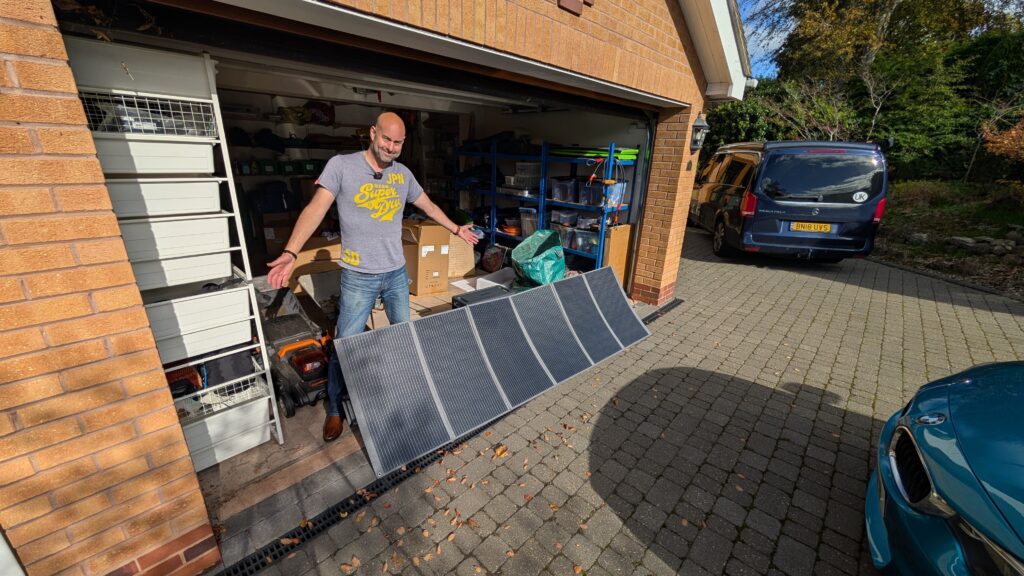
I’ve been testing the P310 with the sort of loads that demonstrate what a power station of this size can actually do. It happily powered my kettle at around 2,700W, ran ~1kW garden power tools with no problems and even ran two of those tools simultaneously. I also hooked it up to AFERIY’s 400W folding solar panel and saw around 300W of solar input during an October spell of UK sunshine.
For conventional tent camping, I think the P310 is probably too big and heavy for most people. You can get it into the car and the wheels and telescopic handle make moving it around considerably easier, but it’s not a power station I’d want to carry any significant distance. My view changes quite dramatically for campervans and motorhomes, though. Leave it installed or stored in the vehicle and that enormous capacity, powerful inverter, 25A 12V XT60 output and solar charging capability start to make much more sense.
It’s also interesting beyond camping. During my testing I found myself thinking about garages, sheds and allotments without mains electricity, where the 3,600W output means the P310 can become a useful hub for power tools. It also makes sense as an emergency backup power source at home, particularly given that AFERIY specifies a less-than-10ms UPS switchover.
There are things I would change. I’d like a second high-power USB-C port, the telescopic handle doesn’t feel as rugged as some competitors I’ve used, and the display can’t be configured to remain permanently illuminated. Above all, 42kg is 42kg. This is a large power station and you need to have a realistic use for something this substantial.
But having used it, my overall impression is extremely positive. The P310 is well put together, has an excellent selection of outputs, a genuinely useful adjustable AC charging control and a comprehensive smartphone app. Most importantly, during my testing it simply got on with powering everything I threw at it.
Camping Secrets quick verdict: If you want a small power station for charging phones, lights and a cool box on a weekend camping trip, the AFERIY P310 is overkill. If, however, you’re looking for a very high-capacity power station for a campervan, motorhome, off-grid setup, workshop or emergency home power, it’s a seriously impressive piece of kit and one I have no hesitation in recommending.
The biggest attraction may be the amount of battery and inverter capacity you’re getting for the money. At the time of writing, AFERIY’s UK store lists the standalone P310 at £1,259, although prices and promotions can of course change.
Use code CAMPINGSECRETS for an extra cash discount at the official Afirey website
Aferiy P310 Key Specifications
Before getting into the individual features, it’s worth looking at the numbers. The AFERIY P310 is very much a high-capacity power station, combining a whopping 3,840Wh LiFePO4 battery with a 3,600W AC inverter, plus relatively high mains and solar charging limits.
Battery Capacity
The P310 has a 3,840Wh (3.84kWh) internal battery. To put that figure into context, 3.84kWh is a substantial amount of stored energy for a portable power station. Inevitably, the energy actually available to AC appliances will be lower than the nominal battery capacity because some power is lost through the inverter and the power station’s own electronics.
The important point is that this is a power station designed for more than simply topping up phones and laptops. The capacity is large enough to make higher-powered appliances and longer periods away from mains electricity realistic propositions.
Battery Chemistry and Lifespan
The P310 uses LiFePO4, or lithium iron phosphate, battery cells. AFERIY rates the battery for more than 3,500 charge cycles.
LiFePO4 has become the preferred chemistry for many modern power stations, particularly larger models such as this. Longevity is especially relevant with a 3.84kWh power station because this is the sort of product you’re likely to expect to keep for many years.
Also worth noting is the five-year warranty, which is reassuring for a product containing a battery of this size and value.
AC Power Output
The P310 provides 3,600W of continuous AC output through its three UK mains sockets.
That’s enough power to move beyond the relatively undemanding equipment associated with smaller camping power stations.
I tested this by plugging in a kettle, which showed approximately 2,700W on the P310’s display while operating. The power station ran it without a problem.
I also tested roughly 1kW garden power tools individually and then ran two together, which gives a more useful indication of the sort of equipment its inverter can handle than the headline output figure alone.
Dimensions and Weight
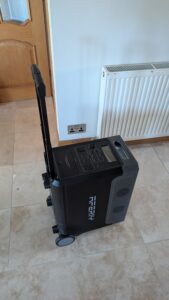
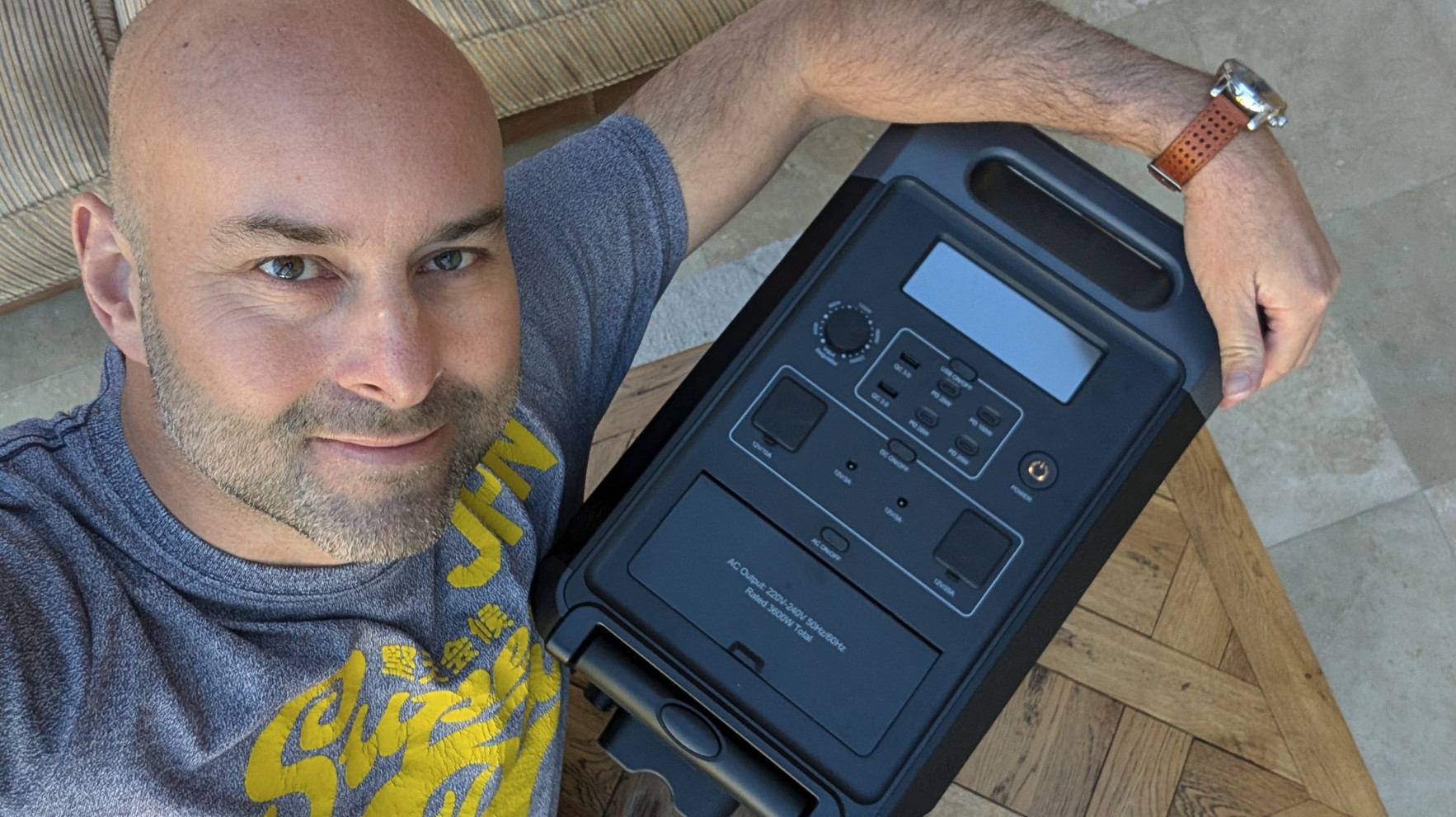
The P310 measures approximately 58cm long, 32cm deep and 46cm high, with a weight of ~42kg which I varied by standing on some scales whilst holding it.
That weight is probably the specification worth paying most attention to.
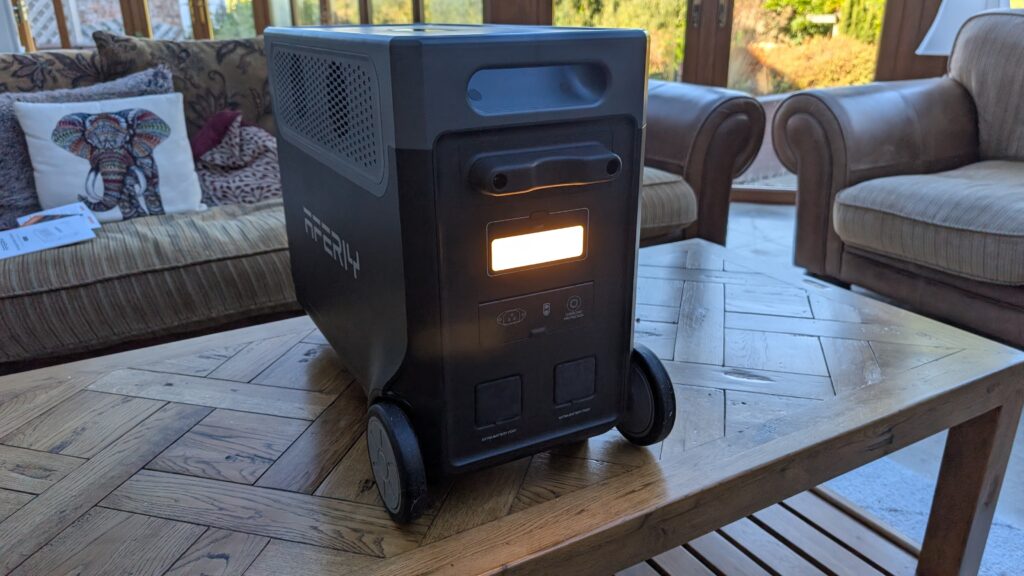
Technically it is portable. There are handles for lifting it, together with wheels and a telescopic handle for moving it around. In practical terms, however, 42kg isn’t something most people will want to carry very far.
The ability to stand the P310 vertically is therefore useful, particularly when space is limited in a car, campervan or at home.
AC, USB and DC Outputs
There’s a good selection of connections on the P310.
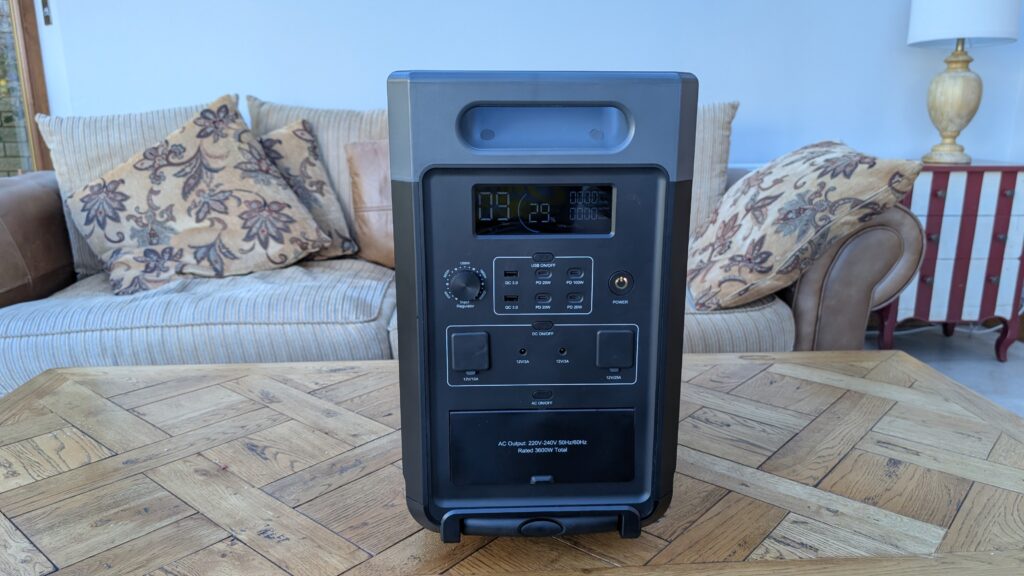
At the front are three UK 220–240V AC sockets, sharing the power station’s 3,600W AC output.
There are also six USB outputs:
- 2 x USB-A Quick Charge 3.0 ports, rated at up to 18W each
- 3 x USB-C ports, rated at up to 20W
- 1 x USB-C port, rated at up to 100W
The 100W USB-C connection is particularly useful for compatible laptops and other higher-powered USB-C devices. Personally, at this capacity and price point, I would have preferred two 100W USB-C ports rather than one.
For 12V equipment, there’s a conventional 12V/10A car-style socket providing up to 120W, as well as a 12V/25A XT60 output.
That higher-current XT60 connection is one of the more interesting features for campervan and motorhome users.
Solar Input
The P310 supports up to 2,000W of solar input, with a specified DC input range of 12–160V.
That’s a high solar ceiling for a portable power station and potentially important if you’re considering the P310 for extended off-grid use.
The unit uses an XT90 connection at the power station and is supplied with a cable terminating in MC4 connectors for connecting solar panels.
I’ll look at solar performance in more detail later in the review, including my test with AFERIY’s 400W folding panel.
Mains Charging
AC charging is another strong point.
The P310 accepts up to 2.2kW from the mains. During testing, I set it to maximum and watched the input gradually ramp up to around 2.2kW on the display.
More interestingly, there’s a physical rotary control on the front of the P310 that allows you to reduce the AC charging rate. The power can be adjusted down to 400W rather than always charging at full speed. This can extend the lifespan of the battery cells in the P310.
I particularly like this feature because it means you don’t have to reach for the smartphone app simply to change the charging rate.
Car Charging
The P310 can also be charged from a vehicle’s 12V supply.
In the review, the quoted charging rate was 120W, with a full charge taking around 32 hours at that rate.
That’s obviously much slower than mains or high-powered solar charging and highlights the limitation of trying to refill such a large battery through a conventional 12V car connection.
I’d therefore regard car charging primarily as a supplementary charging option rather than the ideal way to replenish all 3.84kWh.
Expandable Battery Capacity
One of the P310’s more significant features is that the internal battery isn’t the end of the story.
Expansion battery connections at the rear allow additional compatible batteries to be added. When connected, the additional batteries are treated as part of the complete battery system by the P310 and its app.
AFERIY specifies a maximum expanded capacity of 11,520Wh, or 11.52kWh.
That’s almost certainly excessive for conventional tent camping, but potentially much more interesting for a motorhome, off-grid installation or home backup application.
UPS Capability
The P310 can also operate as an uninterruptible power supply (UPS).
AFERIY specifies a transfer time of less than 10 milliseconds.
The principle is straightforward: equipment can be connected to the P310 while the power station itself is connected to mains electricity. If the mains supply fails, the P310 switches to its battery supply. In the video I discuss this as an option for equipment such as computers or servers that you’d prefer not to shut down during a power cut.
Warranty
The P310 comes with a five-year warranty, according to AFERIY and as discussed in my testing.
For me, that’s an important specification rather than an afterthought. Large LiFePO4 power stations are products you buy with the expectation of using them for years, so battery chemistry, cycle life and warranty support matter alongside the more attention-grabbing wattage figures.
On paper, then, the P310 has an unusually broad specification: 3.84kWh of battery storage, 3.6kW AC output, up to 2.2kW mains charging, up to 2kW solar input and expansion to 11.52kWh. The more interesting question is how well all of that has been packaged into something you can realistically live with and use, which brings us neatly to its design and build quality.
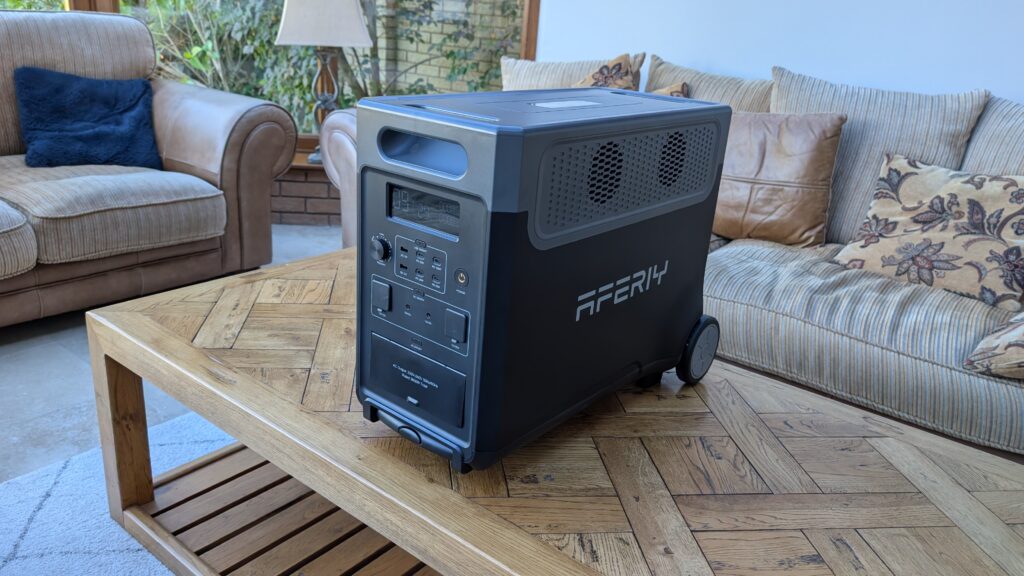
Testing the Aferiy P310
I’ve had the AFERIY P310 for around a month now, which has given me plenty of opportunity to get beyond the initial unboxing stage and use it properly.
When we test power stations for Camping Secrets, I’m much more interested in how they behave in everyday use than whether they can reproduce the numbers printed on the specification sheet. Over the course of my time with the P310, I’ve charged it, discharged it, experimented with different charging rates, used the app, connected solar panels and powered a variety of electrical equipment.
With a power station this size, I also wanted to test it with some genuinely substantial loads. There’s not much point reviewing a 3,600W power station by plugging in a phone charger.
So I started with something found on plenty of British campsites and one of the simplest high-power tests available: the electric kettle.
Running a 2,700W Kettle
A kettle is actually quite a useful test of a power station inverter. Unlike a phone or laptop charger, it demands a large amount of power continuously while the heating element is operating.
I plugged a standard domestic kettle into one of the P310’s three AC sockets and switched it on.
The display showed the load at around 2,700W. That’s a significant demand, but still comfortably inside the P310’s rated 3,600W continuous AC output.
And there really wasn’t much drama.
The P310 powered the kettle normally and boiled the water without any difficulty. That’s exactly what you want to see. A successful high-power test should ideally be rather uneventful.
It also demonstrates an important distinction between the P310 and smaller camping power stations.
A small power station may contain enough energy to boil a kettle, but that doesn’t necessarily mean its inverter can deliver enough power to run one. With 3,600W available from the P310, appliances drawing two or three kilowatts are well within its intended operating range.
Of course, just because you can run high-powered equipment doesn’t mean you should do it unnecessarily. A 2,700W appliance gets through stored energy quickly, so repeated kettle boiling will have a noticeable impact on the battery. We’ll look at what the P310’s 3,840Wh capacity actually means for different camping appliances later in the review.
Running Power Tools
I also wanted to try something quite different.
Over the month or so I’ve been testing the P310, one use case that has increasingly made sense to me is as a large portable power source for places where there isn’t an easily accessible mains supply.
That could obviously mean a campervan or an off-grid camping pitch, but equally it could mean a garage, workshop, allotment or shed.
Power tools provide a useful test because electric motors place a different type of demand on an inverter from a simple resistive load such as a kettle.
Leaf Blower Test
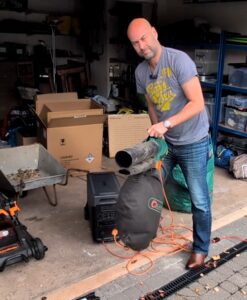
First up was my mains-powered leaf blower.
With the blower running, I was seeing a load of approximately 1,000W on the AFERIY’s display. The P310 ran it without any problems.
A 1kW load is well within the P310’s abilities, of course, but this test was useful for another reason. It showed me how practical something with this much battery capacity could be as a temporary electricity supply away from the mains.
Instead of charging a cordless tool battery, I could simply plug a conventional mains tool directly into the P310.
Hedge Trimmer Test
Next, I tried my hedge trimmer.
Again, this presented a load of around 1kW, and again the P310 ran it normally.
Neither of these individual tests gets particularly close to the 3.6kW limit, so I decided to make things a little more interesting.
Running Multiple Appliances at Once
I ran the two garden tools together.
The P310 was therefore supplying roughly 2kW of combined load, and it continued to operate normally.
For me, this is a more meaningful demonstration of the P310 than plugging lots of small electronic devices into its USB sockets.
During a month of using a large power station, you begin to realise that its main advantage isn’t necessarily its ability to run one extraordinary piece of equipment. It’s the fact that you stop having to think quite so carefully about what you plug into it.
There are still limits, obviously. The combined AC load has to remain within the inverter’s ratings, and every watt you consume ultimately has to come from the battery. But a 3,600W inverter provides considerably more flexibility than the lower-powered units we often use for camping.
That’s been the recurring theme of my experience with the P310.
The P310’s specifications are impressive, but specifications only tell half the story. The more important result from my testing is that it has so far handled the substantial real-world loads I’ve connected to it without fuss.
Use code CAMPINGSECRETS for an extra cash discount at the official Afirey website
How Long Will the AFERIY P310 Run Camping Equipment?
The table below uses the P310’s 3,840Wh nominal battery capacity and assumes approximately 85% usable energy after conversion losses, giving an estimated 3,264Wh available to connected equipment. This is a sensible planning figure rather than a guaranteed measurement, as actual results will vary with temperature, inverter efficiency, standby consumption and the behaviour of the appliance. AFERIY specifies the P310 with a 3,840Wh LiFePO4 battery and 3,600W AC output.
Camping equipment | Example power draw¹ | Estimated runtime or usage² | Practical interpretation |
📱 Smartphone | 15Wh per full charge | Around 215 charges | Far more capacity than most groups would need for phones alone |
💻 Laptop | 60Wh per full charge | Around 54 charges | Suitable for extended remote working, subject to the laptop’s battery size |
💡 LED camping lights | 10W | Around 326 hours | Roughly 40 nights at eight hours per night |
📺 Small television | 50W | Around 65 hours | Approximately eight hours per day for eight days |
🧊 Compressor fridge | 45W average³ | Around 72 hours | Approximately three days, depending heavily on ambient temperature and thermostat cycling |
🧺 12V cool box | 50W continuous | Around 65 hours | Continuous-operation estimate; thermoelectric cool boxes can be surprisingly demanding |
🔥 Electric blanket | 75W | Around 43 hours | Potentially several nights of use, depending on heat setting |
☕ Camping coffee | 1,000W | Around 3.3 hours continuous | Approximately 65 three-minute brewing cycles |
🍟 Air fryer | 1,500W | Around 2.2 hours continuous | Roughly eight 15-minute cooking sessions |
🍳 Induction hob | 1,800W | Around 1.8 hours continuous | Around seven 15-minute cooking sessions at full indicated power |
🔌 Domestic kettle | 2,700W | Around 1.2 hours continuous | Approximately 24 three-minute boils at the load observed in my test |
🛠️ Single garden power tool | 1,000W | Around 3.3 hours continuous | Based on the approximate load seen with my leaf blower and hedge trimmer |
🛠️🛠️ Two power tools together | 2,000W combined | Around 1.6 hours continuous | Similar to the combined-load test performed during the review |
¹ Power consumption varies considerably between products. Check the rating label or measure the actual load before relying on these estimates.
² Calculated using: 3,840Wh × 0.85 ÷ appliance wattage. Runtime figures are estimates, not measured results.
³ A compressor fridge switches on and off, so its average consumption may be much lower than its maximum rated power. Hot weather, frequent opening and poor ventilation will increase consumption.
What these figures mean in practice
High-powered appliances are unlikely to run continuously. A kettle may draw around 2,700W, for example, but it only needs to operate for a few minutes at a time. During my testing for Camping Secrets, the P310 powered the kettle normally at approximately this load. It also ran approximately 1kW garden tools individually and two tools simultaneously.
The table therefore shouldn’t be read as suggesting that anyone would run a kettle continuously for 1.2 hours. The useful figure is the estimated number of short operating cycles. Conversely, appliances such as cool boxes, fridges and lighting may remain connected for long periods, making their average consumption particularly important.
The figures also show why the P310 is better suited to energy-intensive camping, campervans and longer off-grid stays than to simple device charging. If your requirements are limited to phones, lights and the occasional laptop charge, much of its 3,840Wh capacity may go unused. If you intend to run refrigeration, cooking appliances and other mains equipment, the larger battery becomes much easier to justify.
Where Does the AFERIY P310 Make Most Sense?
The AFERIY P310 is technically portable, but at 42kg it isn’t something I’d want to move around unnecessarily. After using it for Camping Secrets, I think the best way to judge it is not simply as a camping power station, but as a large-capacity source of portable or semi-permanent power.
Tent Camping
For normal tent camping, I think the P310 is going to be too large for many people.
If you’re mainly charging phones, lights, cameras and laptops, or running a small camping fridge, there are much smaller and lighter power stations that will do the job.
The equation changes for longer trips without electric hook-up, particularly if you want to use mains appliances or have relatively high energy requirements.
Rather than carrying the P310 backwards and forwards to the tent, I’d be inclined to leave it securely in the car or another suitable location and treat it as a central power source for the pitch.
Campervans and Motorhomes
For me, this is one of the P310’s strongest applications.
Once you remove the need to regularly carry 42kg of power station around, its size becomes far less objectionable. It can remain in the campervan or motorhome and provide a large reservoir of energy when you’re away from mains electricity.
The combination of 230V AC outputs, USB charging, conventional 12V output and the higher-current 25A XT60 connection also gives you plenty of options for connecting equipment.
Solar charging is particularly relevant here. If you’re staying off-grid for several days, the ability to put energy back into the battery during daylight becomes considerably more important than simply starting your trip with a large battery.
There’s an interesting question over whether a power station such as this could replace a conventional leisure battery and inverter installation. I wouldn’t say it’s a direct replacement in every vehicle because campervan electrical systems can vary considerably, but for some users the attraction is obvious: battery, inverter, charging electronics, display and outputs are all contained within one unit.
Longer Off-Grid Trips
The P310 becomes progressively easier to justify as the amount of time you intend to spend away from mains electricity increases.
Its 3,840Wh internal battery provides a substantial starting capacity, while compatible expansion batteries can increase total storage considerably.
This is also where the high solar input capability becomes more useful. A big battery is great until it’s empty; being able to replenish it effectively is what turns it into a more practical off-grid power system.
For short trips, that may be unnecessary. For extended stays without hook-up, it’s a very different proposition.
Sheds, Garages and Workshops
One of the more interesting things I discovered while testing the P310 was that I could see myself using it well beyond camping.
During testing I ran mains-powered garden tools from it, including my leaf blower and hedge trimmer. These were drawing around 1kW individually, and I also ran the two together.
That immediately suggests applications in garages, sheds, workshops and other locations where mains electricity isn’t readily available.
Instead of being limited to cordless equipment, you’ve got a portable source of 230V AC power capable of running substantially more demanding equipment.
And in this situation, the weight matters much less. If the P310 spends most of its life sitting in a garage or workshop and only needs to be moved occasionally, 42kg is rather easier to live with.
Home Backup During a Power Cut
The other obvious application is emergency power at home.
With several kilowatt-hours of stored energy available, the P310 could keep selected equipment operating during a power cut. Exactly how long depends on what you’re running, which is why the runtime calculations earlier in this review are useful.
The P310 also has UPS functionality, giving it another potential role for equipment that you’d prefer not to switch off unexpectedly.
I would make an important distinction here, though. The P310 is not the same thing as a permanently installed whole-house battery system.
I’d think of it instead as a substantial standalone backup supply. You decide which appliances or equipment are important and connect those to the power station.
So, Where Would I Use It?
After living with the P310, I think its usefulness increases almost in direct proportion to how little you need to move it.
For lightweight tent camping, it’s difficult to justify hauling a 42kg power station around unless you have unusually large electricity requirements. You’d be better off looking at our dedicated camping power pack buying guide.
Put exactly the same unit in a campervan, however, and it begins to make much more sense. Leave it in a garage, workshop or off-grid building and the weight becomes less important again. Use it as emergency home backup and portability may barely matter at all.
That’s an important point because I don’t think the P310 should simply be judged as a very large camping power station.
It’s better viewed as a substantial portable energy system that also happens to be useful for certain types of camping.
Use code CAMPINGSECRETS for an extra cash discount at the official Afirey website
AFERIY P310 Price and Value for Money
At the time of writing, AFERIY lists the P310 at £1,259 in the UK, reduced from a stated RRP of £2,199. Prices for power stations change regularly, though, so I’d always check the latest price before buying.
At £1,259, you’re getting 3,840Wh of LiFePO4 battery capacity and a 3,600W pure sine wave inverter, with the option to expand the battery capacity to 11,520Wh. There are also 13 outputs, up to 100W USB-C charging, high-power solar charging and a sub-10ms UPS function.
That works out at roughly 33p per Wh of nominal battery capacity, which is a useful basic measure when comparing similarly specified power stations.
Value isn’t just about battery capacity, though. Over my time testing the P310 for Camping Secrets, I’ve been more impressed by the fact that its capacity is backed up by enough inverter power to make proper use of it. My 2,700W kettle test is a good example. Having nearly 4kWh of stored energy is much more useful when you can also run demanding mains appliances.
The obvious alternatives come from established power-station brands such as EcoFlow, BLUETTI, Anker SOLIX and Jackery. I wouldn’t compare the P310 with those products purely on battery capacity or headline wattage, however. Warranty support, software, after-sales service, physical design and long-term reliability should all form part of the decision.
On paper, though, the P310 provides a lot of battery and inverter capacity for £1,259.
For me, the more important question is whether you actually need it. Paying £1,259 for 3.84kWh can represent good value if you’re going to use that capacity in a campervan, motorhome, off-grid setup or as home backup. If you only need to charge a few phones and run a camping fridge for the weekend, a smaller and cheaper power station will almost certainly make more sense.
In short: the P310 looks particularly competitive on capacity and output for the money, but it’s good value only if you’ll actually make use of what it offers.
Use code CAMPINGSECRETS for an extra cash discount at the official Afirey website
AFERIY P310 Review: Verdict
After using the AFERIY P310 extensively, I’ve come away impressed. It combines a 3,840Wh battery with a 3,600W pure sine wave inverter, and in my testing it has comfortably dealt with the high-powered equipment I’ve connected to it.
It isn’t perfect. At 42kg, it is very heavy, and that limits its appeal for conventional tent camping. The wheels help, but the telescopic handle doesn’t feel quite as substantial as I’d like on something of this weight. I’d also have preferred a second 100W USB-C port, and it’s frustrating that I can’t configure the display to remain permanently on.
None of those issues has significantly detracted from using it, though.
What I’ve particularly liked is the combination of battery capacity and genuinely useful output power. There’s little point carrying around nearly 4kWh of battery if the inverter prevents you from using demanding appliances. That’s certainly not the case here. The P310 is rated for 3,600W AC output, while my own testing included running a kettle drawing around 2,700W as well as mains-powered garden tools.
I’ve also found the adjustable mains charging particularly useful, and the ability to add expansion batteries gives the P310 considerably more scope for serious off-grid or backup use. AFERIY specifies expansion up to 11,520Wh.
For Camping Secrets, my biggest reservation is simply whether most campers need something this large. If you just want to keep phones charged, run a fridge and power a few lights over a weekend, I’d choose something smaller and substantially lighter.
For a campervan or motorhome, however, I think the argument is much stronger. The same applies to longer off-grid stays, workshops and garages without convenient mains electricity, or as a substantial backup power source at home.
Most importantly, during my time with it the P310 has done what I want a good power station to do: provide plenty of usable power without making me think too much about it.
Overall, the shortcomings are relatively minor compared with what the P310 gets right. If its size and weight suit the way you intend to use it, I’m happy to recommend the AFERIY P310. It’s powerful, versatile, expandable and, at the current UK price, offers a compelling amount of battery capacity for the money.
Use code CAMPINGSECRETS for an extra cash discount at the official Afirey website
Frequently Asked Questions: AFERIY P310 Portable Power Station
Q: Can the AFERIY P310 run high-power household appliances and power tools? Yes. With a 3,600W AC inverter, it can easily handle heavy continuous loads. In testing, it successfully ran a 2,700W domestic kettle and simultaneously operated multiple 1kW garden power tools (such as a leaf blower and hedge trimmer).
Q: How portable is the P310? While it features built-in wheels and a telescopic handle, the unit weighs 42 kg. It can be moved short distances over flat surfaces or loaded into a car trunk, but it is generally too heavy for casual tent camping or long-distance carrying. It is best suited for campervans, motorhomes, workshops, off-grid cabins, or home emergency backup.
Q: Can I adjust the AC charging speed? Yes. The P310 features a physical rotary dial on the front panel that allows you to manually adjust the AC charging rate down from 2,200W to as low as 400W without opening the smartphone app.
Q: Is the battery capacity expandable? Yes. You can connect external expansion batteries via the rear expansion ports to increase total capacity from 3,840Wh up to 11,520Wh (11.52kWh).
Q: What output ports are available on the unit?
AC Outlets: 3 x UK 220–240V AC sockets (3,600W total continuous).
USB Ports: 1 x 100W USB-C, 3 x 20W USB-C, and 2 x 18W USB-A Quick Charge 3.0.
DC Outlets: 1 x 12V/10A car-style socket (120W) and 1 x high-current 12V/25A XT60 port.
Q: Does the AFERIY P310 work as an Uninterruptible Power Supply (UPS)? Yes. It features a built-in UPS function with a claimed switchover time of less than 10 milliseconds (<10ms), making it suitable for keeping computers, servers, or critical home gear running seamlessly during a power outage.
Use code CAMPINGSECRETS for an extra cash discount at the official Afirey website